Posts

Showing posts with the label internal combustion engine

Classification of Internal Combustion Engines and Engine Components (automobile engineering)

Image
Diesel Engine Contents Objective 1 : Classification of Internal Combustion Engines Objective 2 : Internal Combustion Engine Components Objective 3 : The Fuel Injector Objective 4 : Supercharging Objective 5 : Cooling System Objective 6 : Engine Cooling Objective 7 : Lubricating Oil Systems Objective 8 : Crankcase Ventilation Objective 9 : Induction and Exhaust Systems Objective 10 : Starting Methods Objective 11 : Engine Monitoring and Protection Objective 12 : Basic Engine Tune-up Objective 13 : Preventive Maintenance Programs Learning Outcome When you complete this learning material, you will be able to: Explain the operating principles, designs, support systems, and operation of industrial internal combustion engines (ICE). Learning Objectives You will specifically be able to complete the following tasks: 1. Explain the principles of compression ignition; describe the operating cycles for twostroke and four-stroke designs. 2. Identify...

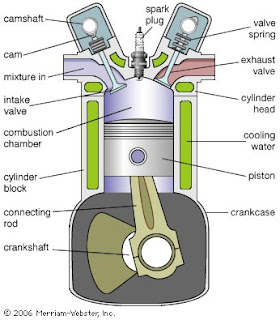
do you know how car engine works?(automobile engineering)

Image
First things , the car engine is an internal combustion engine, of which there are a number of various types including diesel engine , gasoline engine , rotary engine and engine two times . The internal combustion engine works with the basic premise of injecting a small amount of high-energy fuel, eg gasoline or diesel in a small closed space, lighting and creating a massive amount of energy as a gas in expansion. The trick of the internal combustion engine is removed is the accusation of explosions like this hundreds of times for one minute and management to harness the energy that is thus created. Almost all cars use four-stroke cycle combustion to convert fuel into motion, the four strokes being - intake, compression, combustion and exhaust. In the beginning of the cycle the piston starts on top, once the intake valve opens, the piston moves downward, letting the engine take in a cylinder filled with air which also injects a drop Petrol. The piston moves back ...

complete course in internal combustion engines and its cooling system

Image
Internal combustion 1.1) Introduction: The internal combustion engine is an engine in which the combustion of fuel and an oxidizer (typically air) occurs in a confined space called a combustion chamber. This exothermic reaction creates gases at high temperature and pressure, which are permitted to expand. The defining feature of an internal combustion engine is that useful work is performed by the expanding hot gases acting directly to cause movement of solid parts of the engine, by acting on pistons, rotors, or even by pressing on and moving the entire engine itself. We will first starts with the first Engine that had been made to move the first plane and will show The developments that done later to improve it. 2.1) The first 4-stroke internal combustion of a plane This is an computer drawing of one cylinder of the Wright brothers' 1903 aircraft engine. This engine powered the first, heavier than air, self-propelled, maneuverable, pilot...