Posts

Showing posts with the label Air Conditioning

Fundamentals of Refrigeration and Air-Conditioning (course ) 2
Image
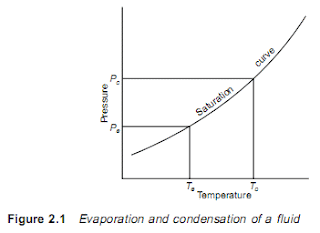
2.1 Basic vapour compression cycle A liquid boils and condenses – the change between the liquid and gaseous states – at a temperature which depends on its pressure, within the limits of its freezing point and critical temperature. In boiling it must obtain the latent heat of evaporation and in condensing the latent heat must be given up again. The basic refrigeration cycle (Figure 2.1) makes use of the boiling and condensing of a working fluid at different temperatures and, therefore, at different pressures. Heat is put into the fluid at the lower temperature and pressure and provides the latent heat to make it boil and change to a vapour. This vapour is then mechanically compressed to a higher pressure and a corresponding saturation temperature at which its latent heat can be rejected so that it changes back to a liquid. The total cooling effect will be the heat transferred to the working fluid in the boiling or evaporating vessel, i.e. the change in enthalpies b...

Fundamentals of Refrigeration and Air-Conditioning (course)

Image
 Refrigeration: The process of removing heat. Air-conditioning: A form of air treatment whereby temperature, humidity, ventilation, and air cleanliness are all controlled within limits determined by the requirements of the air conditioned enclosure. 1.1 Basic physics – temperature The general temperature scale now in use is the Celsius scale, based nominally on the melting point of ice at 0°C and the boiling point of water at atmospheric pressure at 100°C. (By strict definition, the triple point of ice is 0.01°C at a pressure of 6.1 mbar.) On the Celsius scale, absolute zero is – 273.15°C. In the study of refrigeration, the Kelvin or absolute temperature scale is also used. This starts at absolute zero and has the same degree intervals as the Celsius scale, so that ice melts at + 273.16 K and water at atmospheric pressure boils at + 373.15 K. 1.2 Heat Refrigeration is the process of removing heat, and the practical application is to produce or maintain tem...

What is VRF Air Conditioning System?

VRF air-conditioning systems owe their growing popularity to their ability to meet a wide range of requirements, as Tony Nielsen explains. The primary function of all air-conditioning systems is to provide thermal comfort for building occupants. There is a wide range of system types available, staring with the basic window-fitted unit through to the very latest VRF (variable refrigerant flow) equipment. Deciding which system best suits the application will depend on several variables. For example, in a modern, design-conscious office the aesthetic requirements of the client may prove of greater importance than the number of control options they provide. While a client looking for the best life-cycle cost will need to balance capital cost with long-term operating costs, efficiency and predicted VRF systems provide cooling and heating using refrigerant (R407C or R410A) as the working fluid. There are two basic types of VRF system — cooling/heating-only and energy-recovery. Cooling/h...